PRACTICE SERIES 1 · TEST 9
IELTS Academic Writing Practice Test 9
Household spending in 1985 and 2025 · Does international tourism do more harm than good?
Before you begin
Complete both tasks. Allow about 20 minutes for Task 1 and 40 minutes for Task 2. Write at least 150 and 250 words respectively. The timer is shared across both tasks.
Original IELTS-style practice material. Not produced or endorsed by IELTS, the British Council, IDP or Cambridge University Press & Assessment. Drafts save in this browser. Use Submit writing below to save your responses for review; no automatic band score is awarded.
WRITING TASK 1
You should spend about 20 minutes on this task.
The pie charts below show how the average household in one country spent its money in 1985 and 2025.
Summarise the information by selecting and reporting the main features, and make comparisons where relevant.
Write at least 150 words.
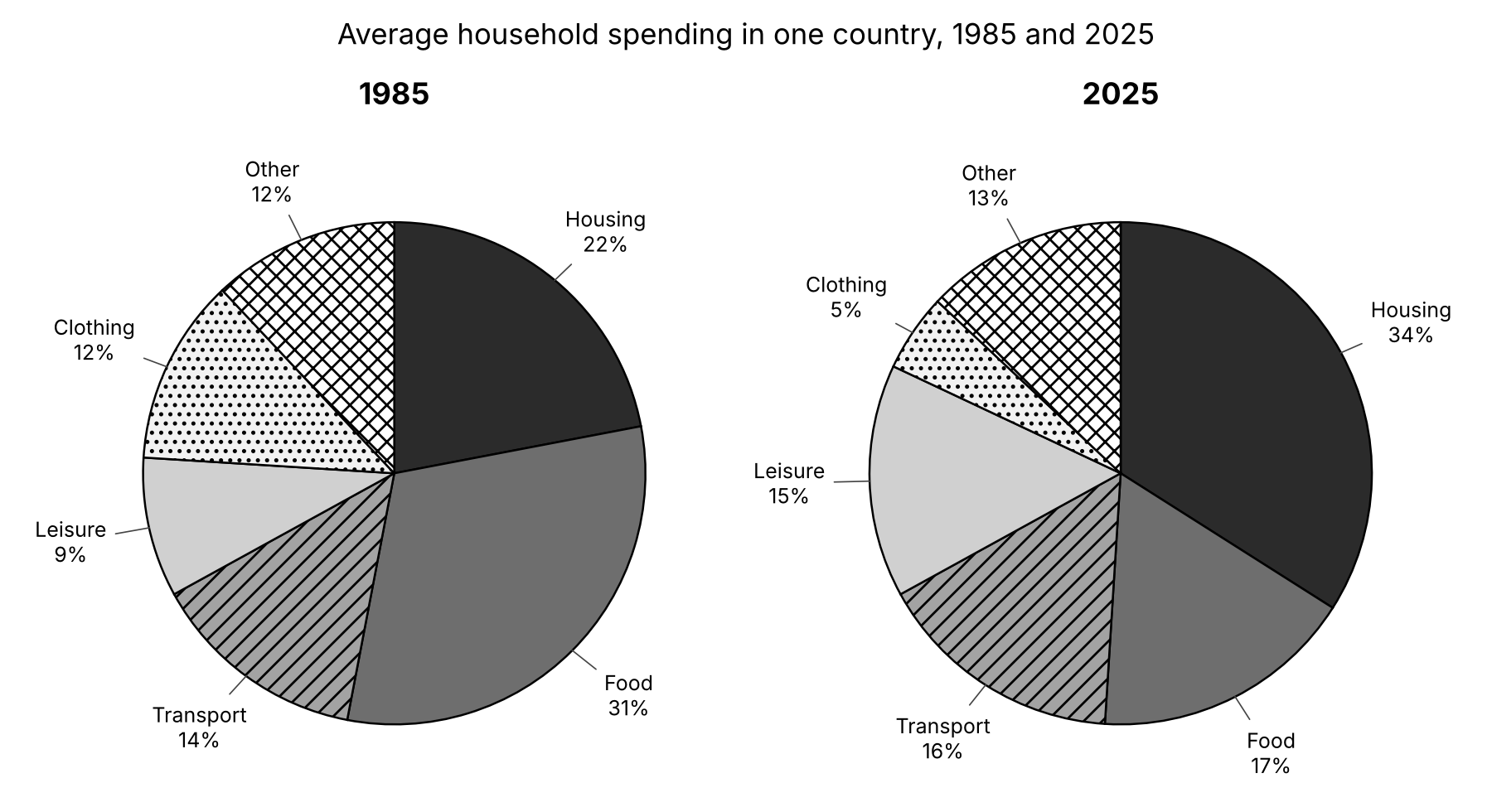
If the charts do not display, use this table. It contains the same information.
| % of household spending | 1985 | 2025 |
|---|---|---|
| Housing | 22 | 34 |
| Food | 31 | 17 |
| Transport | 14 | 16 |
| Leisure | 9 | 15 |
| Clothing | 12 | 5 |
| Other | 12 | 13 |
Write at least 150 words. Suggested time: 20 minutes.
Drafts are saved in this browser. Use Download my writing to keep a separate copy.
View Task 1 sample response and commentary
Write your own response before opening this example. This is a sample from the book, not a score or assessment of your writing.
The two pie charts compare how the average household in one country divided its spending between six categories in 1985 and 2025.
Overall, the pattern of spending changed considerably over the forty years. Food, which had been the largest category in 1985, was overtaken by housing, while leisure took a noticeably larger share and clothing a much smaller one.
In 1985, food accounted for almost a third of household spending (31%), well ahead of housing at 22%. By 2025, however, the position had been reversed. The share spent on housing had risen to just over a third (34%), whereas the proportion spent on food had fallen to 17%, only half of the housing figure.
Leisure saw the second largest increase, rising from 9% to 15%, so that it had moved from the smallest category to the fourth largest. Clothing, in contrast, declined from 12% to just 5% and became the smallest category by some distance.
The remaining two categories changed very little. Transport rose slightly from 14% to 16%, and the share of spending on other items edged up from 12% to 13%.
Commentary
- TA: The overview picks out the key changes (housing replacing food as the largest category, the growth of leisure and the fall in clothing) without listing figures. All six categories are covered accurately, and the response compares the two years and the categories with each other ("only half of the housing figure", "the smallest category by some distance"). It describes the data without guessing at causes that are not shown.
- CC: The body is organised by the size of the change: the two biggest changes first, then the moderate changes, then the stable categories. Referencing and linking are smooth ("By 2025, however", "in contrast", "The remaining two categories").
- LR: The language of proportion is precise and varied ("accounted for almost a third", "just over a third", "took a noticeably larger share", "by some distance").
- GRA: The writer uses a range of accurate structures, including the past perfect ("had been reversed", "had risen"), a non-defining relative clause ("Food, which had been the largest category in 1985, ...") and result clauses ("so that it had moved...").
WRITING TASK 2
You should spend about 40 minutes on this task.
Write about the following topic:
Some people believe that international tourism does more harm than good to the places that tourists visit.
To what extent do you agree or disagree?
Give reasons for your answer and include any relevant examples from your own knowledge or experience.
Write at least 250 words.
Write at least 250 words. Suggested time: 40 minutes.
Drafts are saved in this browser. Use Download my writing to keep a separate copy.
View Task 2 sample response and commentary
Write your own response before opening this example. This is a sample from the book, not a score or assessment of your writing.
International tourism has grown enormously in recent decades, and some people argue that the damage it causes to popular destinations is greater than the benefits it brings. I agree that tourism can cause serious harm, but I believe that, in most places, its advantages are greater, provided that it is properly managed.
There is no doubt that large numbers of visitors can damage a place. In some historic city centres, so many homes have been turned into holiday rentals that local people can no longer afford to live there, and the area loses its character. Popular natural sites can also suffer, as paths are worn away and wildlife is disturbed. In addition, much of the money spent by tourists may go to international hotel chains and travel companies rather than to local people.
However, these problems do not mean that tourism itself is harmful. For many regions, especially poorer ones, it is one of the few industries that can provide large numbers of jobs, from hotel work to guiding and transport. The income from visitors also helps to pay for the protection of the very things that tourists come to see. Many national parks and ancient monuments rely on entrance fees for their upkeep, and some might not survive without them. Tourism can also encourage understanding between cultures, as visitors learn about the history and traditions of the places they visit.
Moreover, the harmful effects of tourism can be reduced. Some cities now limit the number of homes that can be let to holidaymakers, and some popular sites ask visitors to book a time slot in advance, so that crowds are spread out over the day. Where local communities have a say in how tourism develops, more of the money tends to stay in the area.
In conclusion, while international tourism can cause real damage when it is uncontrolled, I believe that its economic and cultural benefits outweigh its disadvantages, and that the right policies can allow destinations to enjoy those benefits without being overwhelmed.
Commentary
- TR: The writer gives a clear position in the introduction (partial disagreement: tourism can be harmful, but its benefits are usually greater if it is managed) and keeps to it throughout. The harms are treated fairly before the writer explains why they are outweighed, and the main ideas are supported with relevant, general examples rather than invented statistics.
- CC: Each body paragraph has a clear purpose (harms, benefits, solutions), and the progression is logical. Linking is varied and accurate ("There is no doubt that", "However", "Moreover", "In conclusion"), and referencing is used well ("these problems", "those benefits").
- LR: The vocabulary is precise and natural ("holiday rentals", "loses its character", "for their upkeep", "book a time slot", "overwhelmed"), with very little repetition.
- GRA: A wide range of complex structures is used accurately, including conditional and concessive clauses ("provided that it is properly managed", "while international tourism can cause real damage"), passives ("are worn away", "can be reduced") and relative clauses.
Clear both responses and reset this writing paper's timer? This cannot be undone.
About the book’s sample responses
Original IELTS-style practice material. Not produced or endorsed by IELTS, the British Council, IDP or Cambridge University Press & Assessment.
About these samples: Each sample was written to show a strong response at roughly Band 7.5–8. The band estimates are based on the public IELTS band descriptors. They are a guide only, not an official score, and no certified examiner has marked these responses. Commentary is organised by the four criteria used for IELTS Writing:
- TA/TR: Task Achievement (Task 1) or Task Response (Task 2)
- CC: Coherence and Cohesion
- LR: Lexical Resource
- GRA: Grammatical Range and Accuracy
Submit your writing
Save both task responses for review. Writing is not given an automatic band score. Name and email are required; phone is optional.