PRACTICE SERIES 1 · TEST 8
IELTS Academic Writing Practice Test 8
How household waste was dealt with · Who should pay for scientific research?
Before you begin
Complete both tasks. Allow about 20 minutes for Task 1 and 40 minutes for Task 2. Write at least 150 and 250 words respectively. The timer is shared across both tasks.
Original IELTS-style practice material. Not produced or endorsed by IELTS, the British Council, IDP or Cambridge University Press & Assessment. Drafts save in this browser. Use Submit writing below to save your responses for review; no automatic band score is awarded.
WRITING TASK 1
You should spend about 20 minutes on this task.
The chart below shows the percentage of household waste in one city that was sent to landfill, recycled, burned to produce energy, or composted in 2005, 2015 and 2025.
Summarise the information by selecting and reporting the main features, and make comparisons where relevant.
Write at least 150 words.
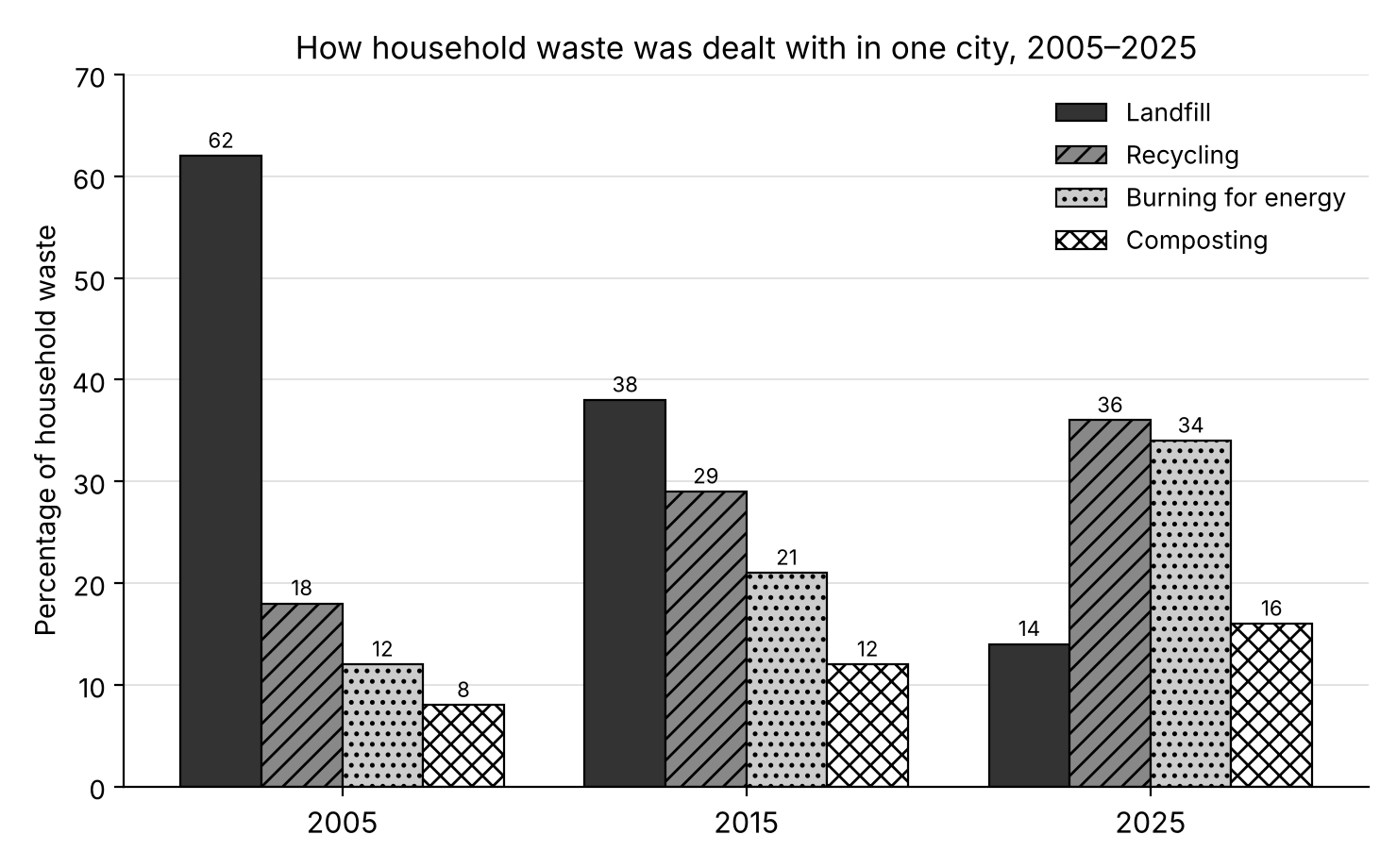
If the chart does not display, use this table. It contains the same information.
| % of household waste | 2005 | 2015 | 2025 |
|---|---|---|---|
| Landfill | 62 | 38 | 14 |
| Recycling | 18 | 29 | 36 |
| Burning for energy | 12 | 21 | 34 |
| Composting | 8 | 12 | 16 |
Write at least 150 words. Suggested time: 20 minutes.
Drafts are saved in this browser. Use Download my writing to keep a separate copy.
View Task 1 sample response and commentary
Write your own response before opening this example. This is a sample from the book, not a score or assessment of your writing.
The bar chart illustrates the proportion of household waste in one city that was sent to landfill, recycled, burned to generate energy or composted in 2005, 2015 and 2025.
Overall, there was a dramatic shift away from landfill over the twenty-year period. In 2005, the majority of waste was buried in landfill sites, but by 2025 this had become the least common method, while recycling and burning for energy had become the two main ways of dealing with waste.
In 2005, landfill accounted for 62% of household waste, more than the other three methods combined. This figure fell steeply to 38% in 2015 and then to just 14% in 2025, less than a quarter of its original level.
Recycling rose from 18% to 29% over the first decade, making it the second most common method in 2015, and it continued to grow, reaching 36% by 2025, the highest share of all. Burning waste to produce energy increased even more rapidly, almost tripling from 12% to 34%, so that by 2025 it was only slightly behind recycling.
Composting remained the smallest category until 2015, but it doubled over the whole period, from 8% to 16%, and by 2025 it was slightly more common than landfill.
Commentary
- TA: The overview identifies the most important change (the move away from landfill) and the new pattern in 2025 without listing figures. Every category is covered, the key figures are accurate, and comparisons are made both over time and between methods ("more than the other three methods combined", "slightly more common than landfill").
- CC: The body is organised by method, starting with the largest change. Each paragraph has a clear focus, and links such as "This figure", "even more rapidly" and "so that" connect ideas smoothly.
- LR: The language of change and proportion is precise and varied ("fell steeply", "almost tripling", "accounted for", "the highest share of all", "less than a quarter of its original level").
- GRA: The writer uses a range of accurate structures, including past perfect ("had become"), participle clauses ("making it the second most common method", "reaching 36%") and comparative forms.
WRITING TASK 2
You should spend about 40 minutes on this task.
Write about the following topic:
Some people believe that scientific research should be paid for and controlled by governments. Others think that private companies are better placed to carry out research.
Discuss both these views and give your own opinion.
Give reasons for your answer and include any relevant examples from your own knowledge or experience.
Write at least 250 words.
Write at least 250 words. Suggested time: 40 minutes.
Drafts are saved in this browser. Use Download my writing to keep a separate copy.
View Task 2 sample response and commentary
Write your own response before opening this example. This is a sample from the book, not a score or assessment of your writing.
Scientific research is expensive, and there is disagreement about whether governments or private companies should fund and direct it. In my view, neither should have complete control, because both sectors bring important strengths.
Those who favour government control have strong arguments. Private companies naturally invest in research that is likely to produce a profit in a few years, such as a new medicine for a common condition in wealthy countries. Research into rare diseases, or into fundamental questions in physics or biology, may have no obvious commercial value, yet such work has often led to major breakthroughs decades later. Because such research may never make a profit, governments are often the only bodies willing to pay for it. Public funding also makes it more likely that results are published openly, rather than kept secret for commercial reasons.
On the other side, supporters of private research point out that giving governments complete control would have serious drawbacks. Governments may favour projects that are politically popular, and their funding can rise and fall with each election. Moreover, private companies are often much better at turning scientific discoveries into practical products. The rapid development of vaccines during the Covid-19 pandemic, for instance, depended on public funding, university research and the manufacturing capacity of private pharmaceutical firms working together. Without companies, many discoveries would never leave the laboratory.
In my view, the best approach is a partnership in which each sector does what it does best. Governments should fund basic research and set clear rules on safety and ethics, while companies should be encouraged to invest in developing new products, perhaps through tax incentives. Where public money has paid for research, governments could also require that the results are shared.
In conclusion, both views contain some truth. Governments should play a leading role in funding long-term research and regulating its use, but private companies are often better at turning discoveries into products. Science advances most effectively when the two work together.
Commentary
- TR: Both views are discussed fully, each with explanation and a relevant example, and the writer's own opinion (that neither sector should have complete control) is stated in the introduction, developed in the fourth paragraph and confirmed in the conclusion.
- CC: The essay moves logically from the case for government control, to its weaknesses, to the writer's own solution. Topic sentences guide the reader, and cohesive devices are used accurately but not mechanically ("On the other side", "Moreover", "for instance", "In my view").
- LR: The vocabulary is precise and suits the topic ("fundamental questions", "commercial value", "manufacturing capacity", "tax incentives", "safety and ethics"), and there are good collocations ("major breakthroughs", "play a leading role").
- GRA: A wide range of complex structures is used accurately, including relative clauses, conditionals ("Without companies, many discoveries would never leave the laboratory") and passive forms.
Clear both responses and reset this writing paper's timer? This cannot be undone.
About the book’s sample responses
Original IELTS-style practice material. Not produced or endorsed by IELTS, the British Council, IDP or Cambridge University Press & Assessment.
About these samples: Each sample was written to show a strong response at roughly Band 7.5–8. The band estimates are based on the public IELTS band descriptors. They are a guide only, not an official score, and no certified examiner has marked these responses. Commentary is organised by the four criteria used for IELTS Writing:
- TA/TR: Task Achievement (Task 1) or Task Response (Task 2)
- CC: Coherence and Cohesion
- LR: Lexical Resource
- GRA: Grammatical Range and Accuracy
Submit your writing
Save both task responses for review. Writing is not given an automatic band score. Name and email are required; phone is optional.