PRACTICE SERIES 1 · TEST 6
IELTS Academic Writing Practice Test 6
Changes to the village of Wexton · Banning advertising aimed at children
Before you begin
Complete both tasks. Allow about 20 minutes for Task 1 and 40 minutes for Task 2. Write at least 150 and 250 words respectively. The timer is shared across both tasks.
Original IELTS-style practice material. Not produced or endorsed by IELTS, the British Council, IDP or Cambridge University Press & Assessment. Drafts save in this browser. Use Submit writing below to save your responses for review; no automatic band score is awarded.
WRITING TASK 1
You should spend about 20 minutes on this task.
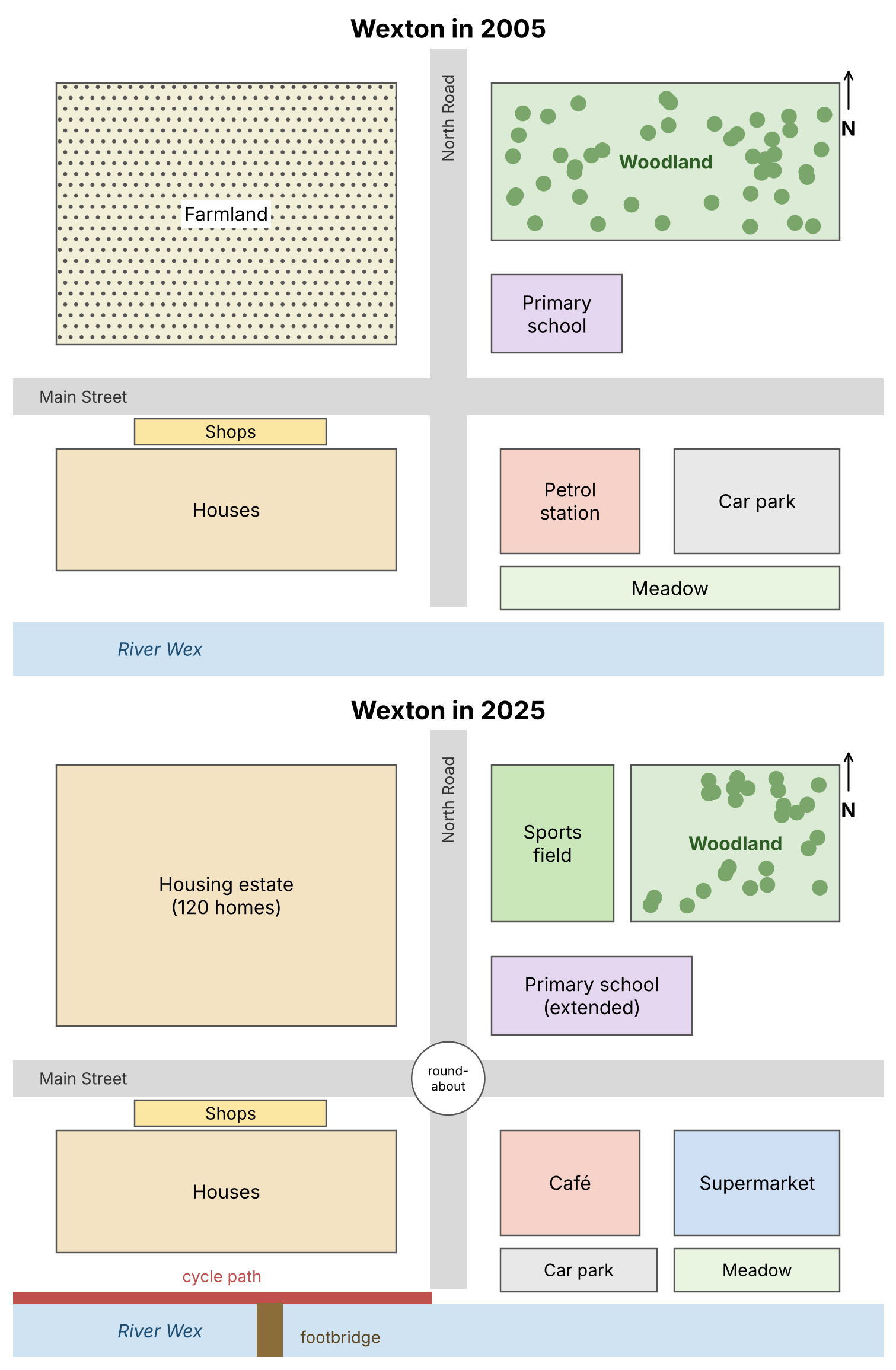
The maps below show the village of Wexton in 2005 and in 2025.
Summarise the information by selecting and reporting the main features, and make comparisons where relevant.
Write at least 150 words.
Write at least 150 words. Suggested time: 20 minutes.
Drafts are saved in this browser. Use Download my writing to keep a separate copy.
View Task 1 sample response and commentary
Write your own response before opening this example. This is a sample from the book, not a score or assessment of your writing.
The maps illustrate how the village of Wexton changed between 2005 and 2025.
Overall, the village became considerably more developed over the twenty-year period. Most of the open land north of Main Street was built on or converted to other uses, and several new facilities for residents were added, while the area of houses and shops south of Main Street stayed the same.
The most significant change took place in the north-west of the village, where the farmland was replaced by a housing estate of 120 homes. To the east of North Road, the western part of the woodland was cleared to make way for a sports field, although the eastern part of the woodland survived. The primary school, which stands between the woodland and Main Street, was extended to the east.
In the south-east of the village, the petrol station was turned into a café, and a supermarket was built on the site of the old car park. A new car park was created on the western part of the meadow, which was therefore reduced to about half its original size.
Transport links were also improved. A roundabout was built where North Road meets Main Street, and a cycle path now runs along the northern bank of the River Wex, west of North Road. Finally, a footbridge was constructed across the river.
Commentary
- TA: The overview identifies the main features clearly: large-scale development north of Main Street, new facilities, and the part of the village that did not change. Every change on the maps is covered accurately, and the writer groups them by area rather than listing them in random order.
- CC: Each body paragraph deals with one area or theme, and location phrases guide the reader ("in the north-west of the village", "To the east of North Road", "In the south-east"). Reference is clear ("which was therefore reduced").
- LR: The vocabulary of change is varied and precise ("was replaced by", "was cleared to make way for", "was turned into", "on the site of", "was constructed").
- GRA: The passive voice, which is often useful when describing maps, is used accurately and with a range of tenses. Relative clauses ("which stands between…") add detail without making sentences difficult to follow.
- Possible improvements: The final paragraph could link the transport changes more closely to the growth in housing, for example by noting that they were added at the same time as the new estate, but only if the writer avoids claiming a reason that the maps do not show.
WRITING TASK 2
You should spend about 40 minutes on this task.
Write about the following topic:
Some people believe that all advertising aimed at children should be banned.
To what extent do you agree or disagree?
Give reasons for your answer and include any relevant examples from your own knowledge or experience.
Write at least 250 words.
Write at least 250 words. Suggested time: 40 minutes.
Drafts are saved in this browser. Use Download my writing to keep a separate copy.
View Task 2 sample response and commentary
Write your own response before opening this example. This is a sample from the book, not a score or assessment of your writing.
Children today are exposed to a huge amount of advertising, not only on television but also in apps, games and online videos. Some people argue that all advertising directed at children should therefore be prohibited. I agree with this view to a large extent, although I think a total ban would be difficult to define and enforce.
The strongest argument for a ban is that young children cannot understand what advertising is. Research suggests that until the age of about eight, many children are unable to distinguish clearly between an advertisement and an ordinary programme, and they tend to believe what they are told. It seems unfair to direct carefully designed persuasion at an audience that cannot recognise it. Moreover, much of the advertising aimed at children promotes products that are harmful in large quantities, such as sugary snacks and drinks. At a time when childhood obesity is rising in many countries, it makes little sense to allow companies to encourage children to consume more of them.
A further problem is the pressure that advertising places on families. Children who see attractive toys and gadgets advertised repeatedly often ask their parents to buy them, and parents on low incomes may feel guilty if they cannot. In this way, advertising can create conflict at home and make children feel that their worth depends on what they own.
On the other hand, a complete ban raises practical difficulties. It is not always clear which advertisements are aimed at children, since many are watched by whole families. In addition, online advertising is increasingly personalised and often comes from companies based in other countries, which makes it hard for national governments to control. Some people also argue that advertising pays for children's programmes and free apps, which might disappear without it.
In conclusion, I believe that the arguments in favour of protecting children outweigh these concerns. Even if a total ban is not achievable, governments should prohibit advertising during children's programmes and on platforms designed for children, and should place particularly strict limits on the promotion of unhealthy food.
Commentary
- TR: The position ("I agree with this view to a large extent") is stated clearly in the introduction and maintained throughout. The main ideas are well developed and supported, and the counter-arguments are presented fairly before the conclusion explains why the writer still supports strong restrictions.
- CC: Paragraphing is logical, with one central idea in each body paragraph. Linking is natural and varied ("Moreover", "A further problem", "In this way", "On the other hand", "In addition").
- LR: The vocabulary is precise and topic-appropriate ("distinguish clearly between", "carefully designed persuasion", "increasingly personalised", "outweigh these concerns"), with good collocation.
- GRA: A wide range of complex structures is used accurately, including conditional forms ("Even if a total ban is not achievable"), relative clauses and passive forms.
- Possible improvements: The reference to research about young children would be more convincing with a brief example of how children respond to adverts. The essay could also explain more clearly how programmes would be paid for if advertising were restricted.
Clear both responses and reset this writing paper's timer? This cannot be undone.
About the book’s sample responses
Original IELTS-style practice material. Not produced or endorsed by IELTS, the British Council, IDP or Cambridge University Press & Assessment.
About these samples: Each sample was written to show a strong response at roughly Band 7.5–8. The band estimates are based on the public IELTS band descriptors. They are a guide only, not an official score, and no certified examiner has marked these responses. Commentary is organised by the four criteria used for IELTS Writing:
- TA/TR: Task Achievement (Task 1) or Task Response (Task 2)
- CC: Coherence and Cohesion
- LR: Lexical Resource
- GRA: Grammatical Range and Accuracy
Submit your writing
Save both task responses for review. Writing is not given an automatic band score. Name and email are required; phone is optional.