PRACTICE SERIES 1 · TEST 14
IELTS Academic Writing Practice Test 14
Millbrook Station then and now · Young people leaving the countryside
Before you begin
Complete both tasks. Allow about 20 minutes for Task 1 and 40 minutes for Task 2. Write at least 150 and 250 words respectively. The timer is shared across both tasks.
Original IELTS-style practice material. Not produced or endorsed by IELTS, the British Council, IDP or Cambridge University Press & Assessment. Drafts save in this browser. Use Submit writing below to save your responses for review; no automatic band score is awarded.
WRITING TASK 1
You should spend about 20 minutes on this task.
The plans below show the ground floor of Millbrook railway station in 2000 and today.
Summarise the information by selecting and reporting the main features, and make comparisons where relevant.
Write at least 150 words.
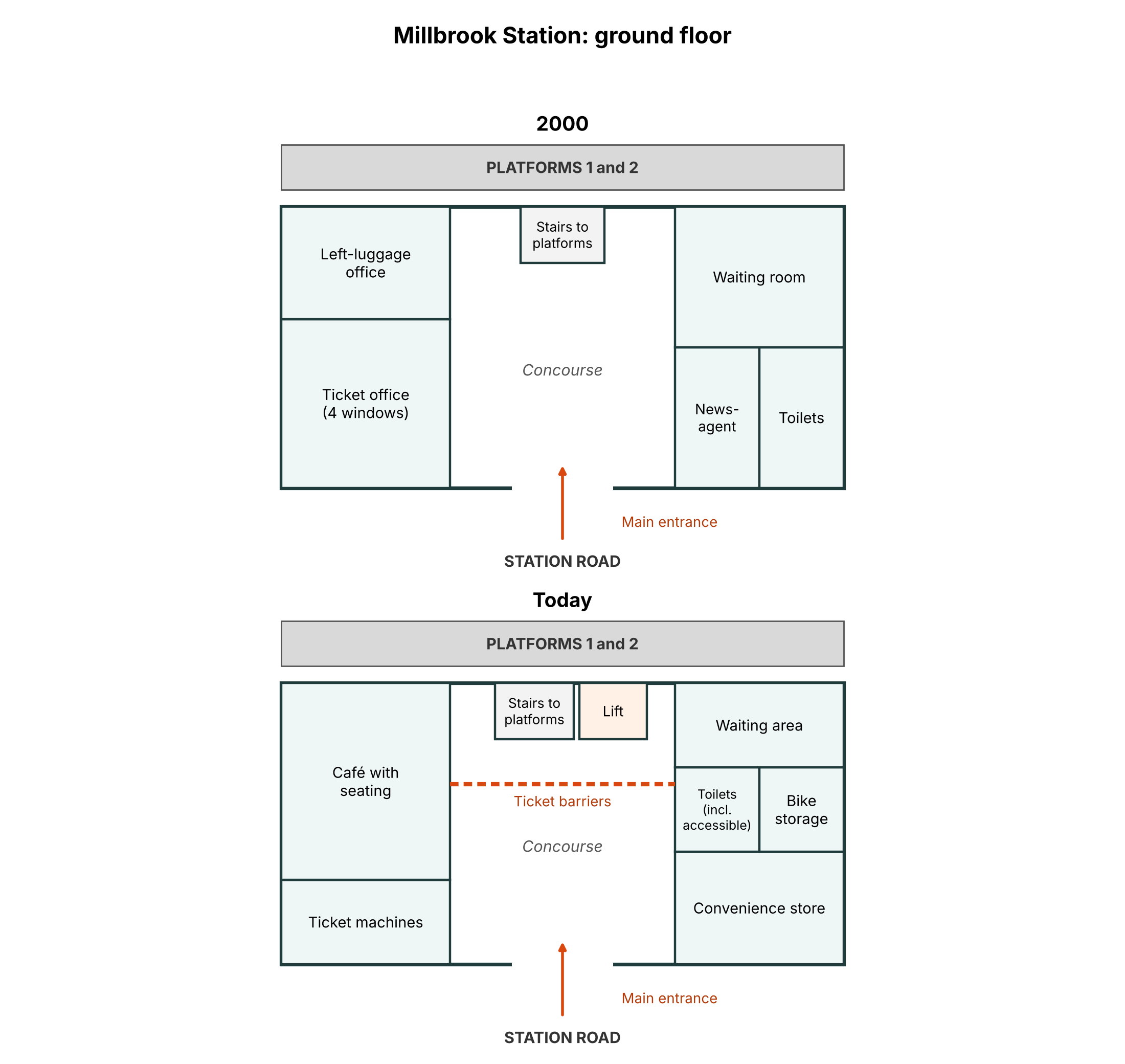
If the plans do not display, use this list. It contains the same information.
Millbrook Station: ground floor
Part of the building 2000 Today Left side, front Ticket office (4 windows) Ticket machines (smaller area) Left side, back Left-luggage office Café with seating (also takes the back half of the old ticket office) Centre Open concourse; stairs to the platforms at the back Concourse; ticket barriers across the middle; stairs and a new lift to the platforms Right side, front Newsagent and toilets Convenience store (whole width) Right side, back half Waiting room Middle: toilets (including an accessible toilet) and bike storage; back: a smaller waiting area Main entrance Centre of the front wall, from Station Road Unchanged
Write at least 150 words. Suggested time: 20 minutes.
Drafts are saved in this browser. Use Download my writing to keep a separate copy.
View Task 1 sample response and commentary
Write your own response before opening this example. This is a sample from the book, not a score or assessment of your writing.
The plans show how the ground floor of Millbrook railway station has changed since 2000.
Overall, the station has been modernised. Facilities for buying tickets and storing luggage have been reduced or removed, while more space is now given to food and shopping, and access to the platforms has been improved.
The most noticeable changes are on the left of the building. In 2000, this side was taken up by a large ticket office with four windows and, behind it, a left-luggage office. Today, tickets are sold from machines in a much smaller area at the front, and the rest of this side, including the former left-luggage office, has been turned into a café with seating.
In the centre, the concourse is still entered from Station Road through the main entrance, which has not moved. However, ticket barriers now run across the middle of the concourse, and a lift has been built next to the stairs that lead up to the platforms.
On the right-hand side, the newsagent and the toilets at the front have been replaced by a convenience store, which occupies the full width. The toilets, which now include an accessible one, have been moved further back, next to a new bike storage area. As a result, the waiting room, which once filled the back half of this side, has become a smaller waiting area.
Commentary
- TA: The overview identifies the main trends (less space for tickets and luggage, more for food and shopping, better access). Every change is reported, and the one feature that stayed the same (the entrance) is noted.
- CC: The description moves logically through the building (left, centre, right), so the reader can follow it like a map. Referencing ("this side", "which", "As a result") is clear.
- LR: Appropriate language for describing plans: "taken up by", "turned into", "replaced by", "occupies the full width", "the former left-luggage office".
- GRA: Passive forms are used accurately and naturally ("has been turned into", "has been built", "have been moved"), with relative clauses and a mix of present perfect and past simple.
WRITING TASK 2
You should spend about 40 minutes on this task.
Write about the following topic:
In many countries, young people are leaving villages and small towns to live in large cities.
What problems does this cause, both for rural areas and for cities? What can be done to solve these problems?
Give reasons for your answer and include any relevant examples from your own knowledge or experience.
Write at least 250 words.
Write at least 250 words. Suggested time: 40 minutes.
Drafts are saved in this browser. Use Download my writing to keep a separate copy.
View Task 2 sample response and commentary
Write your own response before opening this example. This is a sample from the book, not a score or assessment of your writing.
In many countries, villages are losing their young people to the cities. This movement creates serious difficulties in both places, but I believe there are practical steps that governments and businesses can take to reduce them.
For rural areas, the main problem is that communities slowly empty and grow older. When young adults leave, there are fewer people to work on farms or to start businesses, and fewer children to keep local schools open. Once a school, a shop or a bus service closes, life becomes even harder for the people who remain, which encourages more families to leave. In some regions of southern Europe, for example, whole villages now have only a handful of elderly residents.
Cities face the opposite problem. A rapid rise in population puts pressure on housing, transport and public services. Rents increase, and many newcomers end up in overcrowded or poor-quality accommodation on the edge of the city, often a long journey from their work. Traffic and pollution also grow as more people compete for the same space.
Several measures could help. The most effective, in my view, would be to make it possible for young people to build a career without moving to a city. Fast internet connections would allow many to work remotely for city employers, and tax incentives could encourage companies to open offices or factories in smaller towns. Governments could also support rural services, for instance by keeping village schools open even when they have few pupils, since a school is often what persuades a family to stay.
As far as cities are concerned, the priority should be housing. Building more affordable homes near public transport, rather than on the outskirts, would allow newcomers to live decently without adding to traffic.
In conclusion, the movement of young people to cities weakens rural communities and overloads urban ones. Although it is unlikely to stop completely, better jobs, connections and services in the countryside, together with well-planned housing in cities, could make the situation far more manageable.
Commentary
- TR: Both parts of the question are answered, and problems are given for both rural areas and cities, as the question requires. Solutions are linked to the problems, and the writer's view of the most effective measure is clear.
- CC: A clear structure (problems for villages, problems for cities, solutions for villages, solutions for cities). The "vicious circle" in paragraph two is explained step by step.
- LR: Precise topic vocabulary ("put pressure on", "public services", "work remotely", "tax incentives", "affordable homes", "the outskirts"), used naturally.
- GRA: A wide range of structures, including time clauses ("Once a school... closes"), conditionals, relative clauses and a participle phrase, with very few errors.
Clear both responses and reset this writing paper's timer? This cannot be undone.
About the book’s sample responses
Original IELTS-style practice material. Not produced or endorsed by IELTS, the British Council, IDP or Cambridge University Press & Assessment.
About these samples: Each sample was written to show a strong response at roughly Band 7.5–8. The band estimates are based on the public IELTS band descriptors. They are a guide only, not an official score, and no certified examiner has marked these responses. Commentary is organised by the four criteria used for IELTS Writing:
- TA/TR: Task Achievement (Task 1) or Task Response (Task 2)
- CC: Coherence and Cohesion
- LR: Lexical Resource
- GRA: Grammatical Range and Accuracy
Submit your writing
Save both task responses for review. Writing is not given an automatic band score. Name and email are required; phone is optional.