PRACTICE SERIES 1 · TEST 13
IELTS Academic Writing Practice Test 13
Rainfall and temperature in two cities · Why the news is mostly bad
Before you begin
Complete both tasks. Allow about 20 minutes for Task 1 and 40 minutes for Task 2. Write at least 150 and 250 words respectively. The timer is shared across both tasks.
Original IELTS-style practice material. Not produced or endorsed by IELTS, the British Council, IDP or Cambridge University Press & Assessment. Drafts save in this browser. Use Submit writing below to save your responses for review; no automatic band score is awarded.
WRITING TASK 1
You should spend about 20 minutes on this task.
The graphs below show the average monthly rainfall and temperature in two cities.
Summarise the information by selecting and reporting the main features, and make comparisons where relevant.
Write at least 150 words.
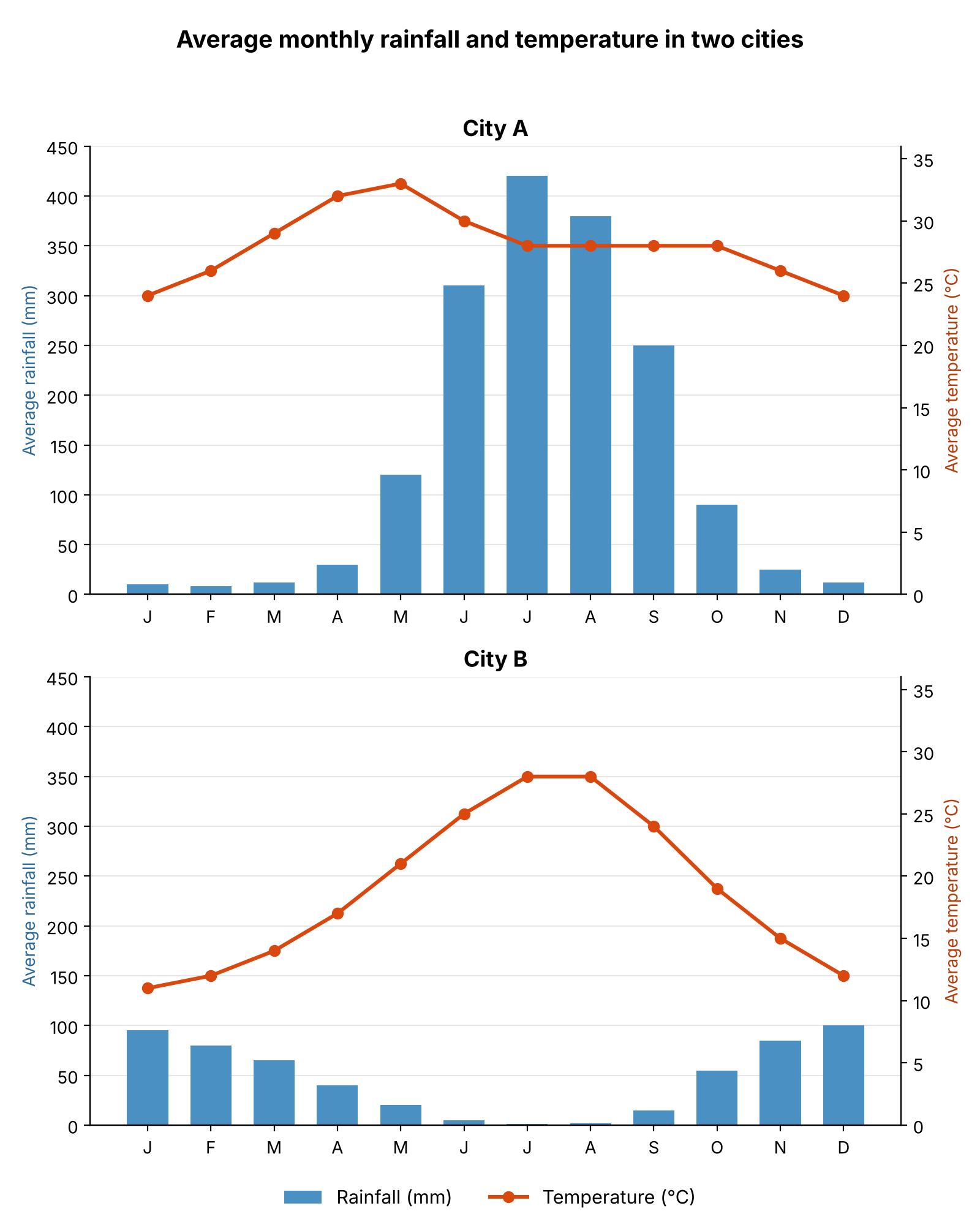
If the graphs do not display, use this table. It contains the same information.
| Month | J | F | M | A | M | J | J | A | S | O | N | D |
|---|---|---|---|---|---|---|---|---|---|---|---|---|
| City A rainfall (mm) | 10 | 8 | 12 | 30 | 120 | 310 | 420 | 380 | 250 | 90 | 25 | 12 |
| City A temperature (°C) | 24 | 26 | 29 | 32 | 33 | 30 | 28 | 28 | 28 | 28 | 26 | 24 |
| City B rainfall (mm) | 95 | 80 | 65 | 40 | 20 | 5 | 1 | 2 | 15 | 55 | 85 | 100 |
| City B temperature (°C) | 11 | 12 | 14 | 17 | 21 | 25 | 28 | 28 | 24 | 19 | 15 | 12 |
Write at least 150 words. Suggested time: 20 minutes.
Drafts are saved in this browser. Use Download my writing to keep a separate copy.
View Task 1 sample response and commentary
Write your own response before opening this example. This is a sample from the book, not a score or assessment of your writing.
The graphs compare the average rainfall and temperature in two cities, A and B, in each month of the year.
Overall, the two cities have almost opposite climates. City A is hot all year round and receives most of its rain in the middle of the year, while City B is warm and dry in the middle of the year and cooler and wetter at the start and end of the year. City A is also far wetter in total, with roughly three times as much rain as City B.
In City A, very little rain falls from November to April, when monthly totals are 30 mm or less. Rainfall then rises sharply from May, peaking at 420 mm in July, before falling back to 90 mm in October. Temperatures range only from 24°C to 33°C. Interestingly, the hottest month is May, just before the rains arrive; from June onwards, the temperature drops slightly and stays at around 28°C until October.
City B shows a much wider temperature range, from 11°C in January to 28°C in July and August. Its rainfall follows the opposite pattern to its temperature: the wettest months are December and January, with about 100 mm each, while there is almost no rain at all in June, July and August. In other words, City B is driest when it is hottest, whereas in City A the heaviest rain falls when temperatures are still high.
Commentary
- TA: A clear overview identifies the opposite patterns, the difference in temperature range and the difference in total rainfall. Key figures are selected (420 mm in July, the 24–33°C range, the 11–28°C range) rather than every value being listed, and the feature that City A's hottest month comes before the rains is noticed.
- CC: One paragraph per city, with a final sentence that links them back together ("In other words..."). Referencing is clear ("Its rainfall", "the opposite pattern").
- LR: Precise language for trends and comparison ("rises sharply", "peaking at", "falling back", "a much wider temperature range", "monthly totals").
- GRA: A range of structures, including comparatives ("far wetter", "three times as much rain as"), contrast clauses with "while" and "whereas", and a time clause ("just before the rains arrive"), with no errors.
WRITING TASK 2
You should spend about 40 minutes on this task.
Write about the following topic:
News programmes and newspapers tend to focus on bad news, such as crime, disasters and conflict, rather than on positive stories.
Why do you think this is the case? Should the media report more good news?
Give reasons for your answer and include any relevant examples from your own knowledge or experience.
Write at least 250 words.
Write at least 250 words. Suggested time: 40 minutes.
Drafts are saved in this browser. Use Download my writing to keep a separate copy.
View Task 2 sample response and commentary
Write your own response before opening this example. This is a sample from the book, not a score or assessment of your writing.
Anyone who watches the evening news could be forgiven for thinking that the world is a frightening place. Crime, accidents and conflict fill most of the headlines, while good news, if it appears at all, is saved for the final minute. In my view, this imbalance has understandable causes, but the media should make a deliberate effort to correct it.
The main reason for the focus on bad news is human nature. Psychologists have found that people pay more attention to threats than to pleasant information, probably because in the past, noticing danger helped our ancestors to survive. News organisations depend on attracting viewers and readers, so they naturally choose the stories that grab attention most effectively. In addition, bad news is often sudden and dramatic, whereas good news tends to happen slowly. A plane crash happens in a moment, but a steady fall in child mortality over thirty years does not fit easily into a headline.
Nevertheless, I believe that the media should report more positive stories, for two reasons. First, a constant diet of bad news gives people a distorted picture of reality. Surveys in many countries show that people believe crime is rising even when it is falling, and this fear can affect how they vote and even whether they let their children play outside. Second, endless negative reporting can leave people feeling helpless. If audiences never hear about problems that have been solved, such as a disease that has been controlled or a polluted river that has been cleaned, they may conclude that nothing can be done.
This does not mean that journalists should hide serious problems, which would be a failure of their duty to inform the public. Instead, they could give more space to "solutions journalism": stories that explain not only what has gone wrong, but also how people are trying to put it right.
In conclusion, bad news dominates because it attracts attention, but a more balanced approach would give audiences a more accurate and more hopeful view of the world.
Commentary
- TR: Both questions are answered fully: causes (human attention to threats, commercial pressure, the nature of events) and a clear position on whether more good news should be reported, with a qualification that serious news must not be hidden.
- CC: Each body paragraph has one clear purpose, and the two reasons are signposted ("First", "Second"). The short fourth paragraph anticipates an objection before the conclusion.
- LR: Natural, precise collocations ("grab attention", "a distorted picture of reality", "a constant diet of bad news", "a failure of their duty"), with topic vocabulary used appropriately.
- GRA: Complex sentences are controlled throughout: conditionals ("If audiences never hear..."), relative clauses, a participle phrase, and a cleft-like emphasis ("does not fit easily into a headline").
Clear both responses and reset this writing paper's timer? This cannot be undone.
About the book’s sample responses
Original IELTS-style practice material. Not produced or endorsed by IELTS, the British Council, IDP or Cambridge University Press & Assessment.
About these samples: Each sample was written to show a strong response at roughly Band 7.5–8. The band estimates are based on the public IELTS band descriptors. They are a guide only, not an official score, and no certified examiner has marked these responses. Commentary is organised by the four criteria used for IELTS Writing:
- TA/TR: Task Achievement (Task 1) or Task Response (Task 2)
- CC: Coherence and Cohesion
- LR: Lexical Resource
- GRA: Grammatical Range and Accuracy
Submit your writing
Save both task responses for review. Writing is not given an automatic band score. Name and email are required; phone is optional.