PRACTICE SERIES 1 · TEST 12
IELTS Academic Writing Practice Test 12
Producing woollen yarn · Raising the state pension age
Before you begin
Complete both tasks. Allow about 20 minutes for Task 1 and 40 minutes for Task 2. Write at least 150 and 250 words respectively. The timer is shared across both tasks.
Original IELTS-style practice material. Not produced or endorsed by IELTS, the British Council, IDP or Cambridge University Press & Assessment. Drafts save in this browser. Use Submit writing below to save your responses for review; no automatic band score is awarded.
WRITING TASK 1
You should spend about 20 minutes on this task.
The diagram below shows the stages in the production of woollen yarn from sheep's wool.
Summarise the information by selecting and reporting the main features, and make comparisons where relevant.
Write at least 150 words.
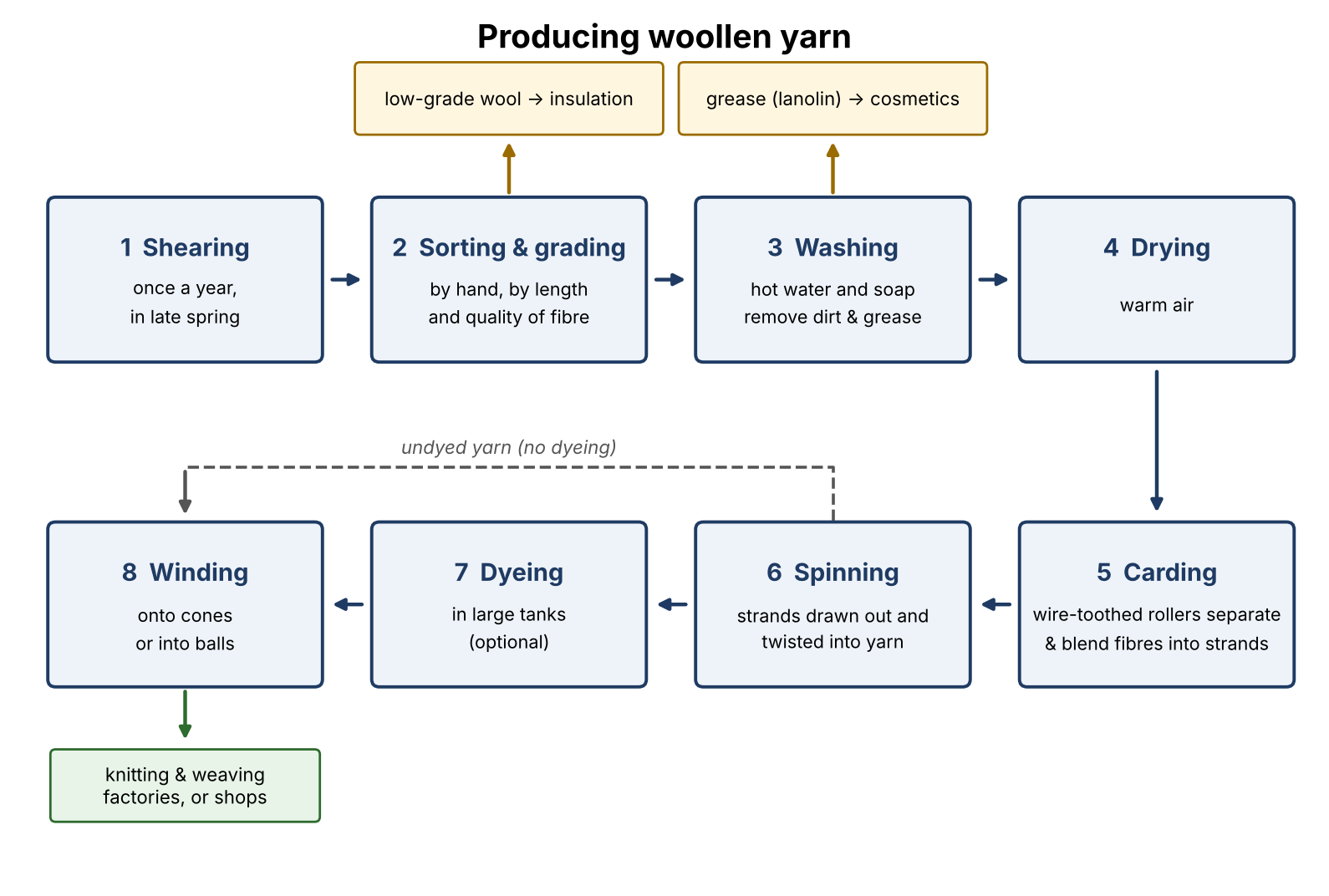
If the diagram does not display, use this list. It contains the same information.
- Shearing: sheep are sheared once a year, in late spring.
- Sorting and grading: the fleece is sorted by hand according to the length and quality of the fibres. Low-grade wool is sent to be made into insulation for buildings.
- Washing: the wool is washed in hot water and soap to remove dirt and grease. The grease (lanolin) is collected and used in cosmetics.
- Drying: the wool is dried with warm air.
- Carding: rollers with fine wire teeth separate and blend the fibres. The web of fibres is divided into soft strands.
- Spinning: the strands are drawn out and twisted into yarn.
- Dyeing: the yarn may be dyed in large tanks (optional). Undyed yarn goes straight from spinning to winding.
- Winding: the yarn is wound onto cones or into balls and sent to knitting and weaving factories, or to shops.
Write at least 150 words. Suggested time: 20 minutes.
Drafts are saved in this browser. Use Download my writing to keep a separate copy.
View Task 1 sample response and commentary
Write your own response before opening this example. This is a sample from the book, not a score or assessment of your writing.
The diagram illustrates the eight stages involved in turning wool from sheep into yarn that is ready to be knitted or woven.
Overall, the process begins with the collection and preparation of the raw wool, continues with a series of machine stages that turn the fibres into yarn, and ends with winding and distribution. Two by-products are also obtained along the way.
First, the sheep are sheared once a year, in late spring. The fleece is then sorted by hand and graded according to the length and quality of its fibres, and any low-grade wool is removed and used to make insulation. Next, the wool is washed in hot water and soap. This removes dirt and grease, and the grease, which is known as lanolin, is collected for use in cosmetics. After being dried with warm air, the clean wool is ready for processing.
In the fifth stage, carding, rollers with fine wire teeth separate and blend the fibres, and the resulting web is divided into soft strands. These strands are drawn out and twisted into yarn during spinning. The yarn may then be dyed in large tanks, although this step is optional, and undyed yarn goes straight on to the final stage. Finally, it is wound onto cones or into balls and sent either to knitting and weaving factories or to shops.
Commentary
- TA: The overview identifies the three broad phases of the process (preparation, machine processing, winding and distribution) and mentions the two by-products. All eight stages are covered in the correct order, with relevant details selected (once a year, by hand, optional dyeing) and no opinions or invented information.
- CC: The response follows the sequence clearly, using a range of sequencers ("First", "then", "Next", "After being dried", "In the fifth stage", "Finally") without overusing any one of them. The two body paragraphs divide the process logically, at the point where the wool is clean and ready for the machines.
- LR: Accurate topic vocabulary taken from the diagram but used flexibly ("fleece", "graded", "by-products", "fibres", "processing"), with paraphrase where possible ("ready to be knitted or woven", "obtained along the way").
- GRA: Passive forms, which are essential for describing a process, are used accurately and varied with active forms ("machines... comb the fibres"). There is also a participle clause ("After being dried with warm air"), a non-defining relative clause ("which is known as lanolin") and a concession ("although this step is optional").
WRITING TASK 2
You should spend about 40 minutes on this task.
Write about the following topic:
Governments in many countries are raising the age at which people can first claim a state pension.
Do the advantages of this development outweigh the disadvantages?
Give reasons for your answer and include any relevant examples from your own knowledge or experience.
Write at least 250 words.
Write at least 250 words. Suggested time: 40 minutes.
Drafts are saved in this browser. Use Download my writing to keep a separate copy.
View Task 2 sample response and commentary
Write your own response before opening this example. This is a sample from the book, not a score or assessment of your writing.
As people live longer and birth rates fall, many governments have decided that people must wait longer before they can claim a state pension. This is an unpopular policy, and it certainly has drawbacks. However, I believe that, provided it is introduced fairly, its advantages outweigh its disadvantages.
The main argument for a later pension age is financial. State pensions are usually paid for by the taxes of people who are currently working. When the number of retired people grows faster than the number of workers, this system comes under severe pressure. Raising the pension age reduces the number of years for which each person receives a pension, and encourages experienced people to stay in the workforce for longer. Without such a change, governments would have to raise taxes sharply or reduce pensions, which would harm younger and older people alike.
There are also benefits for many individuals. People who enjoy their work, or who would otherwise be lonely, may welcome the chance to remain active. Many people in their sixties are now healthier than their grandparents were at the same age, and they have valuable skills to pass on to younger colleagues.
Nevertheless, the policy has serious disadvantages. Not everyone is able to work longer. A builder or a nurse whose job involves heavy physical work may have to stop working in their early sixties, but if the pension age is sixty-seven, they will face several years with no wage and no state pension. Moreover, people in poorer areas tend to have shorter and less healthy lives than the national average, so for them, a higher pension age may mean fewer years of retirement in reasonable health. There is also a risk that older workers will remain in jobs that would otherwise be filled by younger people.
In conclusion, I believe that raising the pension age is necessary and, on balance, beneficial. However, governments must protect those in physically demanding jobs, for example by allowing them to claim part of their pension earlier, so that the burden does not fall on the people least able to carry it.
Commentary
- TR: The question is answered directly: the writer states in the introduction that the advantages outweigh the disadvantages, with a condition, and repeats this in the conclusion. Both sides are developed with clear reasons and examples (the cost of pensions, healthier older people; the income gap for people in physical jobs who must stop work before they can claim, differences in life expectancy). The essay distinguishes the age at which people stop working from the age at which they can claim a pension.. The condition introduced at the start is explained at the end.
- CC: Each paragraph has a clear central idea, and the essay moves logically from the main advantage to secondary advantages and then to the disadvantages. Linking is varied and natural ("The main argument for", "There are also", "Nevertheless", "For these groups").
- LR: Precise, topic-specific vocabulary ("state pension", "birth rates", "the workforce", "physically demanding jobs", "life expectancy" expressed as "shorter and less healthy lives"), with good collocation ("comes under severe pressure", "raise taxes sharply").
- GRA: A wide range of complex structures, used accurately: conditional forms ("Without such a change, governments would have to..."), relative clauses ("whose job involves heavy physical work"), "provided" as a condition, and comparisons ("healthier than their grandparents were").
Clear both responses and reset this writing paper's timer? This cannot be undone.
About the book’s sample responses
Original IELTS-style practice material. Not produced or endorsed by IELTS, the British Council, IDP or Cambridge University Press & Assessment.
About these samples: Each sample was written to show a strong response at roughly Band 7.5–8. The band estimates are based on the public IELTS band descriptors. They are a guide only, not an official score, and no certified examiner has marked these responses. Commentary is organised by the four criteria used for IELTS Writing:
- TA/TR: Task Achievement (Task 1) or Task Response (Task 2)
- CC: Coherence and Cohesion
- LR: Lexical Resource
- GRA: Grammatical Range and Accuracy
Submit your writing
Save both task responses for review. Writing is not given an automatic band score. Name and email are required; phone is optional.