PRACTICE SERIES 1 · TEST 11
IELTS Academic Writing Practice Test 11
Household ownership of five devices · Starting school at four or at seven
Before you begin
Complete both tasks. Allow about 20 minutes for Task 1 and 40 minutes for Task 2. Write at least 150 and 250 words respectively. The timer is shared across both tasks.
Original IELTS-style practice material. Not produced or endorsed by IELTS, the British Council, IDP or Cambridge University Press & Assessment. Drafts save in this browser. Use Submit writing below to save your responses for review; no automatic band score is awarded.
WRITING TASK 1
You should spend about 20 minutes on this task.
The chart below shows the percentage of households in one country that owned five types of electronic device in 2005, 2015 and 2025.
Summarise the information by selecting and reporting the main features, and make comparisons where relevant.
Write at least 150 words.
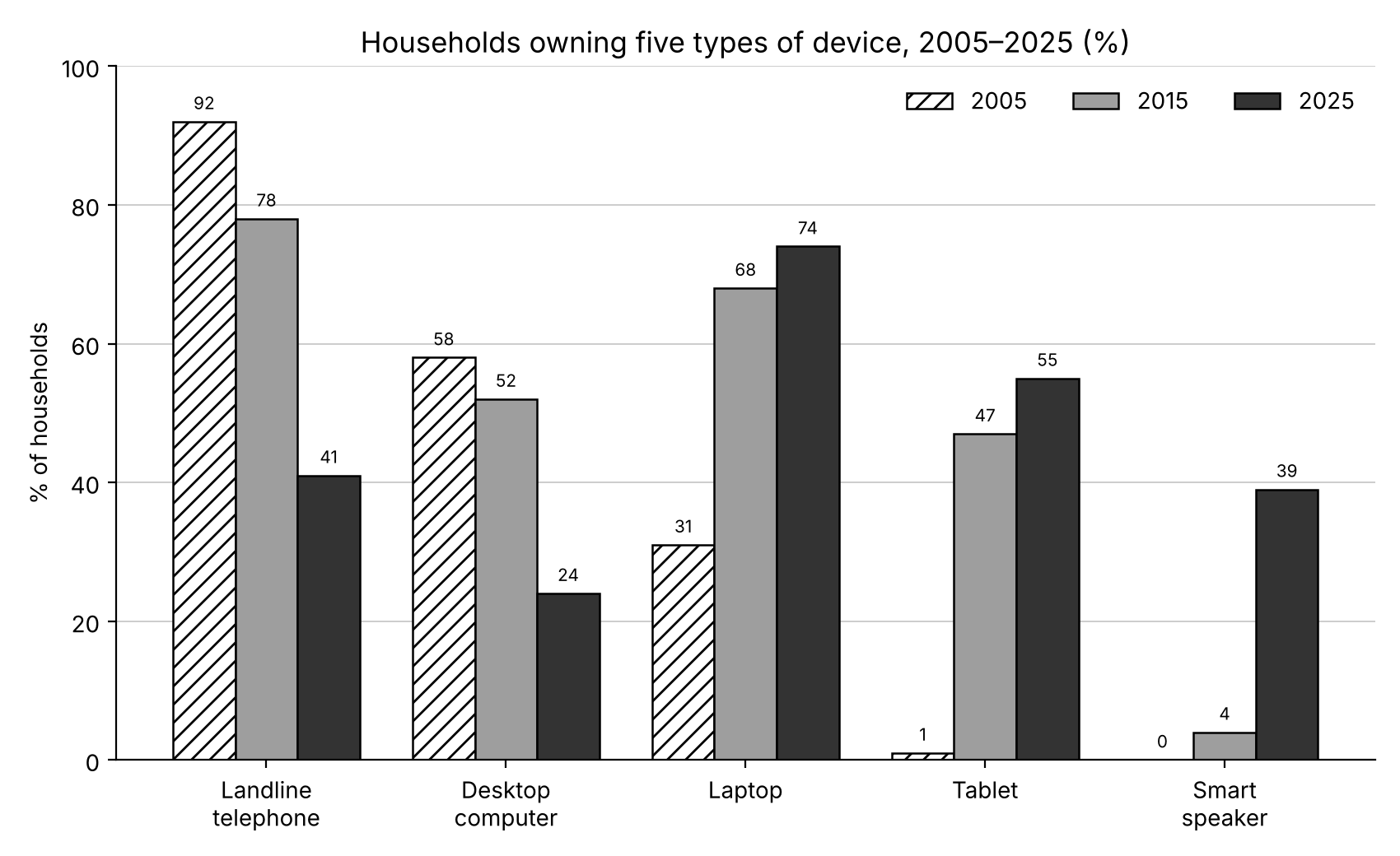
If the chart does not display, use this table. It contains the same information.
| % of households | 2005 | 2015 | 2025 |
|---|---|---|---|
| Landline telephone | 92 | 78 | 41 |
| Desktop computer | 58 | 52 | 24 |
| Laptop | 31 | 68 | 74 |
| Tablet | 1 | 47 | 55 |
| Smart speaker | 0 | 4 | 39 |
Write at least 150 words. Suggested time: 20 minutes.
Drafts are saved in this browser. Use Download my writing to keep a separate copy.
View Task 1 sample response and commentary
Write your own response before opening this example. This is a sample from the book, not a score or assessment of your writing.
The chart illustrates what percentage of households in one country owned each of five electronic devices in 2005, 2015 and 2025.
Overall, ownership of the two older devices, landline telephones and desktop computers, fell considerably, while the three newer devices became far more common. By 2025, laptops had replaced landlines as the most widely owned item.
In 2005, almost every household (92%) had a landline, and well over half (58%) owned a desktop computer. Both figures dropped over the next twenty years, with the decline becoming much steeper after 2015. By 2025, only 41% of homes still had a landline, and fewer than a quarter (24%) had a desktop.
Laptops followed the opposite pattern. Ownership more than doubled from 31% to 68% between 2005 and 2015, before rising more slowly to 74%. Tablets, which were almost unknown in 2005, spread rapidly to nearly half of all homes in 2015 and to 55% by the end of the period. Smart speakers grew most dramatically in the final decade: owned by just 4% of households in 2015, they were found in 39% in 2025, only two percentage points below the figure for landlines.
Commentary
- TA: The overview clearly identifies the two main trends (the decline of the older devices and the rise of the newer ones) and the change in which device was most common. Key figures are selected and compared rather than listed, and the difference in speed of change before and after 2015 is noted. The response does not speculate about reasons.
- CC: Devices are grouped logically: the two falling items in one paragraph and the three rising items in the next, linked by "Laptops followed the opposite pattern". Referencing ("Both figures", "the period", "the final decade") is accurate.
- LR: Precise language of change and proportion ("more than doubled", "well over half", "fewer than a quarter", "spread rapidly", "grew most dramatically"), with little repetition of "owned".
- GRA: A good range of structures, including a non-defining relative clause ("Tablets, which were almost unknown in 2005, ..."), a participle clause ("owned by just 4% of households in 2015, they..."), and the past perfect ("laptops had replaced").
WRITING TASK 2
You should spend about 40 minutes on this task.
Write about the following topic:
Some people believe that children should start formal education at the age of four or five. Others think it is better for children to start school at six or seven.
Discuss both these views and give your own opinion.
Give reasons for your answer and include any relevant examples from your own knowledge or experience.
Write at least 250 words.
Write at least 250 words. Suggested time: 40 minutes.
Drafts are saved in this browser. Use Download my writing to keep a separate copy.
View Task 2 sample response and commentary
Write your own response before opening this example. This is a sample from the book, not a score or assessment of your writing.
The age at which children begin school varies widely between countries. In some, children start formal lessons at four or five, while in others they spend these years at home or in play-based settings until they are six or seven. Both approaches have supporters, but I believe that a later start to formal education, with good-quality play-based care before it, is generally better.
Those who favour an early start argue that young children learn quickly and that school gives them a head start in reading and arithmetic. They also point out that school can help to reduce inequality. Children from homes with few books, or where the language of the school is not spoken, may benefit most from early contact with teachers. In addition, an early start allows parents, particularly mothers, to return to work sooner.
On the other hand, many educators believe that four-year-olds are not ready to sit at desks and follow a fixed timetable. At this age, children develop language, confidence and social skills mainly through play, conversation and physical activity. If they are pushed into formal reading too early, some may struggle, lose confidence and come to see themselves as poor learners. It is also worth noting that several countries where children start school at seven, such as Finland, have achieved strong results in international comparisons, which suggests that an early start is not essential for success.
In my view, the second argument is more convincing, but only if the years before school are well used. A later start does not mean leaving children with nothing to do. The ideal, I believe, is a high-quality nursery or kindergarten that develops children's language and curiosity through play, and is affordable for all families. This would provide the social benefits of early education without the pressure of formal lessons.
In conclusion, although starting school early has some advantages, I believe children benefit more from a later start, provided that good early-years care is available to everyone.
Commentary
- TR: Both views are explained and developed with reasons (early learning, reducing inequality, parents' work; readiness, confidence, international comparison). A clear opinion is given in the introduction, developed in the fourth paragraph with a condition, and restated in the conclusion.
- CC: Each paragraph has a clear focus. Cohesive devices are used naturally ("They also point out", "On the other hand", "It is also worth noting", "In my view"), and the conditional link between the two sides ("but only if the years before school are well used") shows careful argument.
- LR: A wide and accurate range of topic vocabulary ("formal lessons", "play-based settings", "a head start", "reduce inequality", "early-years care", "affordable").
- GRA: A variety of complex structures used accurately, including conditionals ("If they are pushed into formal reading too early, some may struggle"), relative clauses, a "which suggests that" clause, and "provided that".
Clear both responses and reset this writing paper's timer? This cannot be undone.
About the book’s sample responses
Original IELTS-style practice material. Not produced or endorsed by IELTS, the British Council, IDP or Cambridge University Press & Assessment.
About these samples: Each sample was written to show a strong response at roughly Band 7.5–8. The band estimates are based on the public IELTS band descriptors. They are a guide only, not an official score, and no certified examiner has marked these responses. Commentary is organised by the four criteria used for IELTS Writing:
- TA/TR: Task Achievement (Task 1) or Task Response (Task 2)
- CC: Coherence and Cohesion
- LR: Lexical Resource
- GRA: Grammatical Range and Accuracy
Submit your writing
Save both task responses for review. Writing is not given an automatic band score. Name and email are required; phone is optional.