PRACTICE SERIES 1 · TEST 15
IELTS Academic Writing Practice Test 15
How olive oil is produced · Translation tools and language learning
Before you begin
Complete both tasks. Allow about 20 minutes for Task 1 and 40 minutes for Task 2. Write at least 150 and 250 words respectively. The timer is shared across both tasks.
Original IELTS-style practice material. Not produced or endorsed by IELTS, the British Council, IDP or Cambridge University Press & Assessment. Drafts save in this browser. Use Submit writing below to save your responses for review; no automatic band score is awarded.
WRITING TASK 1
You should spend about 20 minutes on this task.
The diagram below shows how olive oil is produced.
Summarise the information by selecting and reporting the main features, and make comparisons where relevant.
Write at least 150 words.
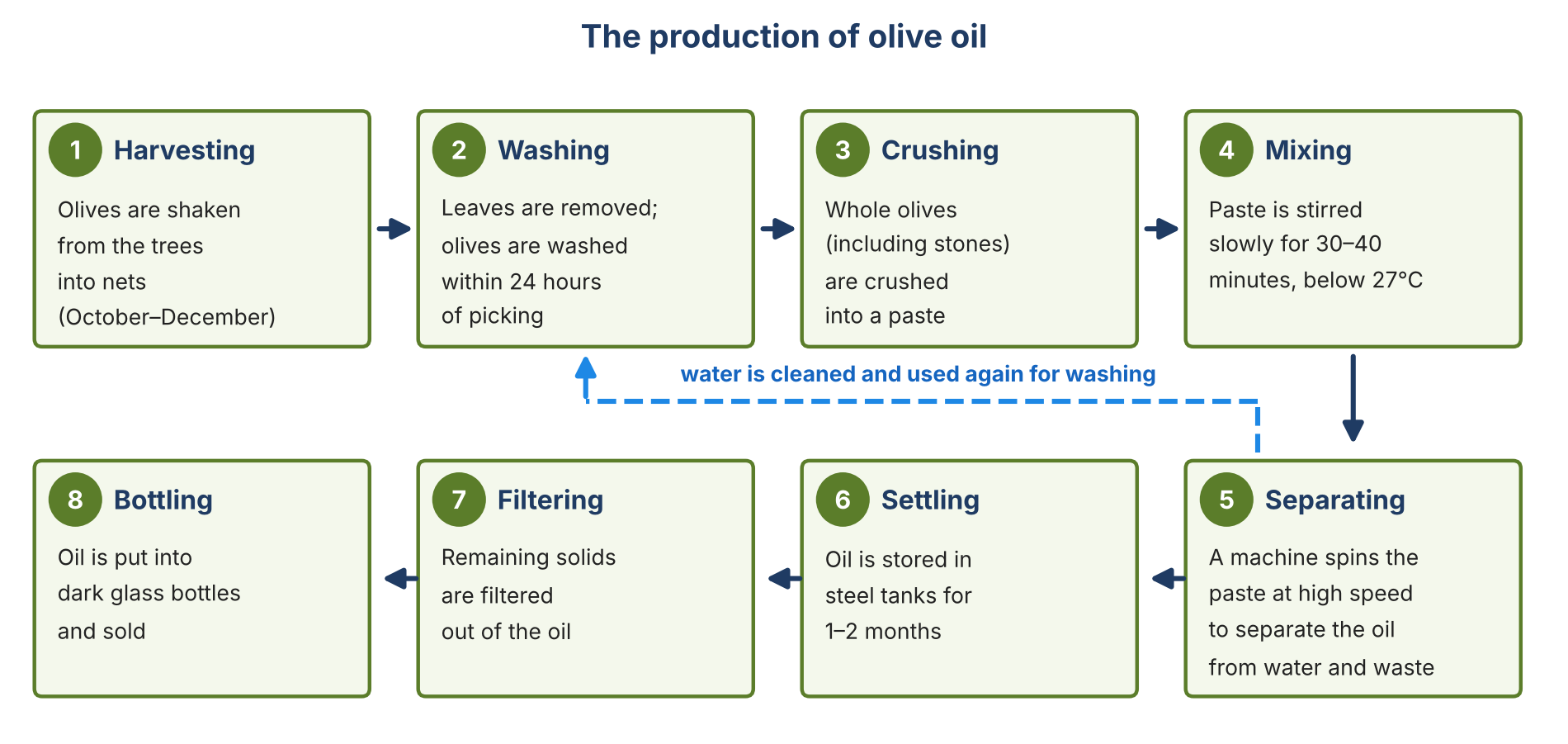
If the diagram does not display, use this list. It contains the same information.
The production of olive oil
- Harvesting: olives are shaken from the trees into nets (October–December).
- Washing: leaves are removed; the olives are washed within 24 hours of picking.
- Crushing: whole olives, including the stones, are crushed into a paste.
- Mixing: the paste is stirred slowly for 30–40 minutes, below 27°C.
- Separating: a machine spins the paste at high speed to separate the oil from water and waste. The water is cleaned and used again for washing (back to stage 2).
- Settling: the oil is stored in steel tanks for 1–2 months.
- Filtering: the remaining solids are filtered out of the oil.
- Bottling: the oil is put into dark glass bottles and sold.
Write at least 150 words. Suggested time: 20 minutes.
Drafts are saved in this browser. Use Download my writing to keep a separate copy.
View Task 1 sample response and commentary
Write your own response before opening this example. This is a sample from the book, not a score or assessment of your writing.
The diagram illustrates the stages involved in producing olive oil, from the harvest to the finished bottle.
Overall, the process consists of eight main steps, which can be divided into two parts: first, the olives are prepared and turned into a paste, and then the oil is extracted from this paste and cleaned. It is also notable that the process is partly circular, since the water separated from the oil is reused.
The process begins between October and December, when the olives are shaken from the trees into nets. Within 24 hours of being picked, their leaves are removed and they are washed. The whole olives, stones included, are then crushed into a paste, which is stirred slowly for 30 to 40 minutes at a temperature below 27°C.
At the fifth stage, a machine spins the paste at high speed in order to separate the oil from the water and solid waste. The water does not go to waste: it is cleaned and sent back to the second stage, where it is used again to wash the next batch of olives.
Meanwhile, the oil is left to settle in steel tanks for one to two months, after which any remaining solids are filtered out. Finally, the oil is poured into dark glass bottles and sold.
Commentary
- TA: The overview groups the eight stages into two phases and highlights a key feature (the water is recycled back into the process). Every stage is covered, with the important details (timing, temperature, storage period).
- CC: The description follows the sequence of the diagram, using a range of sequencers ("The process begins", "then", "At the fifth stage", "Meanwhile", "after which", "Finally"). The loop is explained at the point where it happens, and the writer then returns clearly to the main sequence.
- LR: Accurate process vocabulary ("extracted", "separate the oil from", "left to settle", "filtered out", "batch"), with paraphrase of the diagram's wording ("sent back to the second stage" for "used again for washing").
- GRA: Passive forms are used accurately throughout, as is natural for a process ("are washed", "is cleaned and sent back"), along with relative clauses ("which is stirred", "where it is used again"), "in order to" and "after which".
WRITING TASK 2
You should spend about 40 minutes on this task.
Write about the following topic:
Translation apps and online translation tools are becoming more accurate every year. Some people believe that, as a result, it will soon no longer be necessary for people to learn foreign languages.
To what extent do you agree or disagree?
Give reasons for your answer and include any relevant examples from your own knowledge or experience.
Write at least 250 words.
Write at least 250 words. Suggested time: 40 minutes.
Drafts are saved in this browser. Use Download my writing to keep a separate copy.
View Task 2 sample response and commentary
Write your own response before opening this example. This is a sample from the book, not a score or assessment of your writing.
Thanks to rapid improvements in technology, a traveller can now point a phone at a menu or speak into an app and receive an instant translation. This has led some people to argue that learning foreign languages will soon be unnecessary. While I accept that translation tools will reduce the need for language skills in some situations, I strongly disagree that language learning will become pointless.
It is true that, for simple and practical purposes, translation apps are already remarkably effective. A tourist ordering a meal, a shopper reading a product label or a business checking the meaning of a short email can now manage without knowing a word of the language. For these everyday transactions, it would be unrealistic to expect most people to spend years learning a language they will use only occasionally.
However, communication involves far more than exchanging information. Much of what people mean depends on tone, humour and cultural context, which even the best software often misses. A doctor explaining a diagnosis to a frightened patient, or a diplomat negotiating a delicate agreement, cannot rely on a machine that may choose the wrong word at a critical moment. In addition, speaking through a device creates distance. Someone who has taken the trouble to learn another person's language is able to build a relationship of trust that a translated conversation rarely achieves.
There are also benefits to learning a language that have nothing to do with translation at all. Studying a foreign language helps people to understand how their own language works, and it gives them direct access to another culture's literature, films and ways of thinking. Some research also suggests that it improves memory and concentration.
In conclusion, although translation technology will make language skills less essential for routine tasks, it cannot replace the deeper understanding and personal connection that come from knowing a language. For this reason, I believe that learning foreign languages will remain valuable for a long time to come.
Commentary
- TR: A clear position (strong disagreement, with a partial concession) is stated in the introduction and maintained throughout. The concession paragraph makes the argument more balanced and convincing, and each main idea is supported with specific examples.
- CC: Well organised: concession, then two main reasons for disagreeing, then a conclusion. Paragraphs are linked logically ("It is true that", "However", "There are also benefits"), and referencing is clear.
- LR: Precise and natural vocabulary ("everyday transactions", "cultural context", "a delicate agreement", "build a relationship of trust", "direct access"). The writer avoids repeating the word "translation" by paraphrasing.
- GRA: A wide range of structures, including relative clauses, an "it is true that" structure, a present perfect in a relative clause ("who has taken the trouble"), and complex noun phrases, with very few errors.
Clear both responses and reset this writing paper's timer? This cannot be undone.
About the book’s sample responses
Original IELTS-style practice material. Not produced or endorsed by IELTS, the British Council, IDP or Cambridge University Press & Assessment.
About these samples: Each sample was written to show a strong response at roughly Band 7.5–8. The band estimates are based on the public IELTS band descriptors. They are a guide only, not an official score, and no certified examiner has marked these responses. Commentary is organised by the four criteria used for IELTS Writing:
- TA/TR: Task Achievement (Task 1) or Task Response (Task 2)
- CC: Coherence and Cohesion
- LR: Lexical Resource
- GRA: Grammatical Range and Accuracy
Submit your writing
Save both task responses for review. Writing is not given an automatic band score. Name and email are required; phone is optional.