Cambridge IELTS 6 · Listening Test 3

Cambridge IELTS 6 · Academic · Practice paper

Opening a bank account

Cambridge IELTS 6 · Listening Test 3

All four parts of the paper — 40 questions. Play the recording, then use 10 minutes to review your answers. Type your answers, then check them and review the key.

Press Start listening to play the recording. You can pause and resume. Your answers are saved on this device.

0 / 40 answered
Recording 00:00

Ready to start listening.

1

Opening a bank account

Questions 1–10 · A conversation at a bank

Complete the form below.
Write NO MORE THAN ONE WORD OR A NUMBER for each answer.

Opening a bank account

Application for aCurrent bank account
Type of current accountThe account
Full name of applicantPieter Henes
Date of birth
Joint account holdersNo
Current address Exeter
Time at current address
Previous addressRielsdorf 2, Utrecht, Holland
Telephonework
Occupation
Identity (security)Name of his : Siti
Opening sum£ to be transferred from Fransen Bank, Utrecht
StatementsEvery
RequestsSupply information about the bank’s service
2

The history of Rosewood House

Questions 11–20 · A talk about a historic house and its grounds

Choose the correct letter, A, B or C.

11When the writer Sebastian George first saw Rosewood House, he

12Before buying the house, George had

13According to the speaker, George viewed Rosewood House as

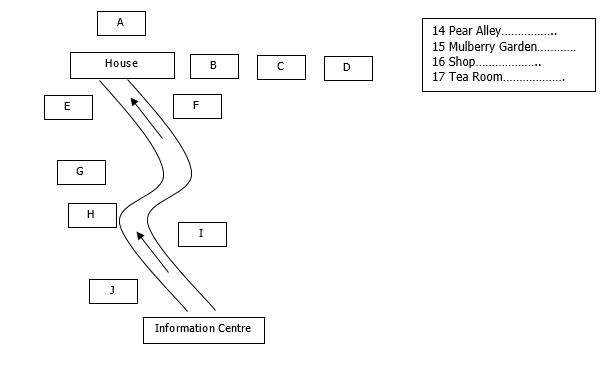
Label the map below.
Write the correct letter, A–J, next to questions 14–17.

Rosewood House grounds map. House near top left; Information Centre at bottom. A is above House; B, C and D are to its right. E and F flank the upper path. G and H are on the left of the middle path; I is to the right of the lower path, and J is near the Information Centre.
Use this map for Questions 14–17.
  • 14Pear Alley
  • 15Mulberry Garden
  • 16Shop
  • 17Tea Room

Complete the sentences below.
Write ONE WORD ONLY for each answer.

River walk

  1. 18You can walk through the that goes along the river bank.
  2. 19You can go over the and then into a wooded area.
  3. 20On your way back, you could also go up to the .
3

Marketing assignment: music preferences

Questions 21–30 · Two students plan a survey

Complete the sentences below.
Write NO MORE THAN THREE WORDS OR A NUMBER for each answer.

Marketing assignment

  1. 21For their assignment, the students must investigate one part of the .
  2. 22The method the students must use to collect data is .
  3. 23In total, the students must interview people.
  4. 24Jack thinks the music preferences of listeners are similar.

Complete the notes below.
Write NO MORE THAN TWO WORDS for each answer.

Marketing survey: music preferences

Age group of interviewee

  • 25 or under
  • 45 or over

Music preferences

  • Pop
  • 25
  • Folk
  • Easy listening
  • 26

Medium for listening to music

  • Radio
  • CD
  • TV
  • 27

Source of music

  • Music shops
  • 28
  • Internet

Places for listening to music

  • Disco
  • Pub
  • 29
  • Concert hall
  • 30
4

Neolithic Ireland

Questions 31–40 · A lecture on farming, tools and pottery

Choose the correct letter, A, B or C.

31According to the speaker, it is not clear

32What point does the speaker make about breeding animals in Neolithic Ireland?

33What does the speaker say about the transportation of animals?

34What is the main evidence for cereal crops in Neolithic Ireland?

Complete the sentences below.
Write NO MORE THAN TWO WORDS for each answer.

Stone tools

  1. 35Ploughs could either have been pulled by or by cattle.
  2. 36In the final stages of axe-making and were necessary for grinding and polishing.
  3. 37Irish axes were exported from Ireland to and England.

Pottery making

The colonisers used clay to make pots.

  1. 38The of the pots was often polished to make them watertight.
  2. 39Clay from areas was generally used.
  3. 40Decoration was only put around the of the earliest pots.
Answer key & marking notes

Question 36 accepts water and sand in either order; dates accept 27-1-1973 or 27 January 1973. Questions 14–17 refer to the map in the book. Band estimates use the published Academic Listening conversion and are indicative only.